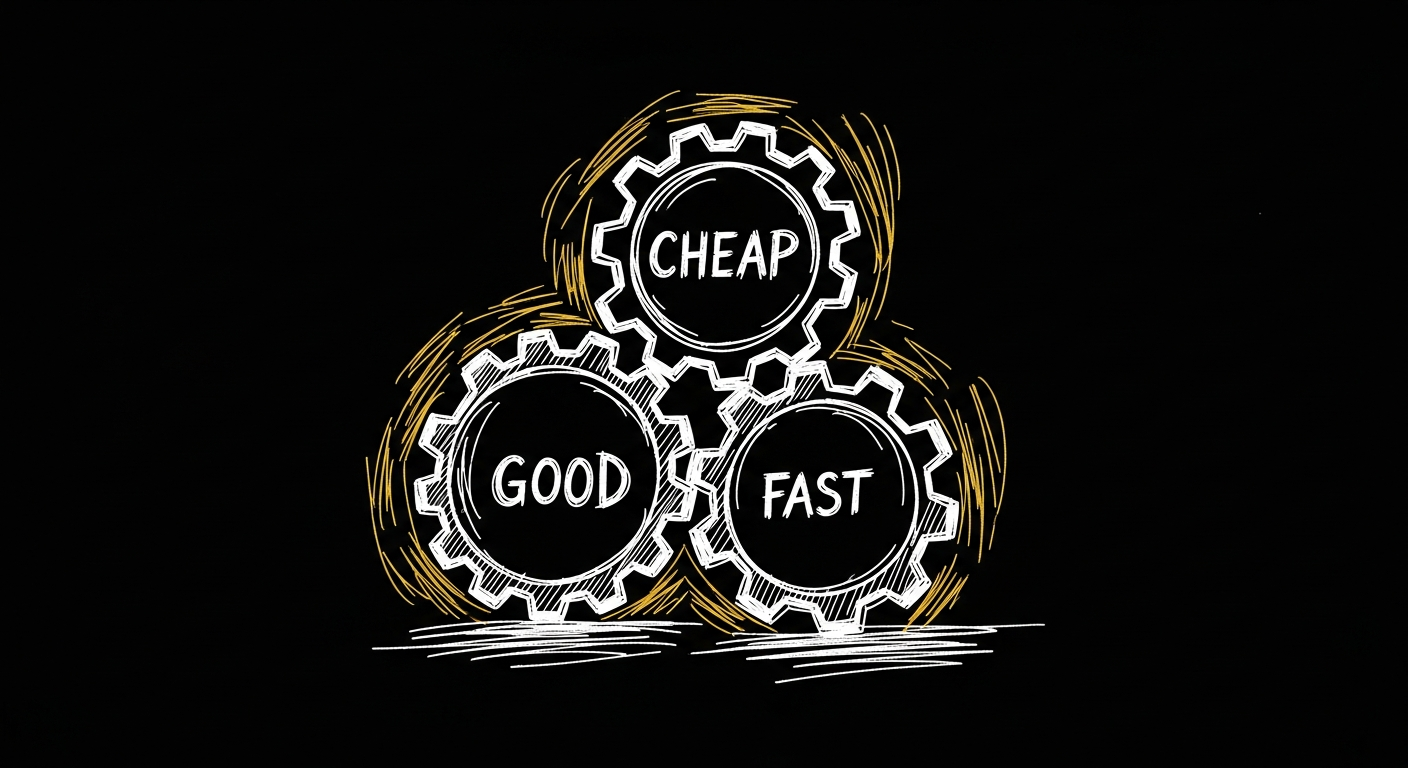
The Good, Cheap, Fast paradox states that clients can choose any two qualities but never all three simultaneously. Good and fast requires premium pricing. Good and cheap requires extended timelines. Fast and cheap sacrifices quality. Understanding this constraint helps freelancers and agencies set realistic client expectations and avoid projects that promise the impossible. Explaining it early prevents scope creep and disappointment.
Every client wants excellent work delivered quickly at a low price. Every freelancer knows that’s not how reality works. The tension between these positions creates most client conflicts, scope creep, and project failures. The Good, Cheap, Fast framework isn’t just a clever saying—it’s a practical tool for having honest conversations early, setting boundaries that stick, and building client relationships based on realistic expectations rather than wishful thinking.
Key Takeaways
- Pick two, never three: Good + Fast = Expensive. Good + Cheap = Slow. Fast + Cheap = Low quality. No combination delivers all three.
- Use it early: Introduce the framework in initial conversations before quoting—it sets realistic expectations from the start
- Not an excuse: The framework explains constraints, not your inability to deliver. Poor work isn’t justified by low prices.
- Client education: Most clients don’t understand production realities; this gives them a mental model for trade-offs
- Scope protection: When clients request additions, the framework explains why timeline or price must adjust
What Is the Good, Cheap, Fast Paradox?
The Good, Cheap, Fast paradox is a project management principle stating that any project can achieve at most two of three desirable qualities: high quality (good), low cost (cheap), and quick delivery (fast). Achieving all three simultaneously is impossible.
The principle appears across industries from construction to software to creative services. It’s not a matter of skill or efficiency—it reflects fundamental constraints on resources, time, and human capacity. Even the most talented professionals working at peak efficiency cannot produce premium results instantly at bargain prices.
The framework helps explain why certain client requests are unrealistic. When someone asks for outstanding work, delivered by Friday, at a budget rate, they’re asking for a logical impossibility. One of those three requirements must yield for the other two to be met.
Understanding this isn’t pessimistic—it’s practical. The framework enables honest conversations about trade-offs and helps both providers and clients make informed decisions about where to compromise based on their priorities.
- Good: High quality, attention to detail, meets or exceeds expectations
- Cheap: Low cost, budget-friendly, minimal financial investment
- Fast: Quick turnaround, short timeline, immediate delivery
- Constraint: Any two are achievable; all three are not
Why Can’t You Have All Three?
You can’t have all three because quality work requires time, speed requires prioritisation (which costs money), and low prices require either reduced quality or extended timelines to remain sustainable for the provider.
Good work takes time because quality comes from iteration, review, and refinement. First drafts rarely match final expectations. Testing reveals problems. Revision improves outcomes. Rushing eliminates these quality-building steps.
Fast delivery requires prioritisation. When you need something urgently, the provider must drop other work, often paying premium rates for rush resources, working overtime, or sacrificing other commitments. These disruptions have real costs that must be covered.
Cheap pricing requires efficiency, which typically means either standardised processes (less customisation) or extended timelines (fitting work around higher-paying projects). Providers charging below-market rates either cut corners or work slower to make the economics viable.
| Combination | What It Requires | What You Sacrifice |
|---|---|---|
| Good + Fast | Premium resources, overtime, priority scheduling | Low price (must pay for speed) |
| Good + Cheap | Extended timeline, flexible deadlines | Speed (must wait longer) |
| Fast + Cheap | Simplified scope, reduced standards | Quality (must accept compromises) |
How Do You Explain This to Clients?
Explain the Good, Cheap, Fast framework early in client conversations—ideally before quoting—using a simple visual or verbal explanation that positions it as a universal constraint, not your specific limitation.
Frame it neutrally: “There’s a principle in project work that applies everywhere, not just our industry. Any project can be good, cheap, or fast—but you can only pick two. Which two matter most for this project?” This positions you as educating, not making excuses.
Use relatable examples. “If you need your website by Friday and it needs to be exceptional, that’s achievable, but it requires dedicated resources and premium scheduling—so it won’t be cheap. If budget is fixed, we can deliver great work affordably by extending the timeline. What’s your priority?”
Let clients choose their trade-off rather than making the decision for them. Some will prioritise speed, others budget, others quality. Their choice informs your quote and sets expectations for how the project will proceed.
- Timing: Introduce early, before quoting or scoping
- Framing: Universal principle, not your limitation
- Method: Let clients choose which two they prioritise
- Outcome: Aligned expectations before work begins
What Happens When Clients Expect All Three?
When clients expect all three, projects typically fail through missed deadlines, scope creep, quality disputes, or provider burnout. Someone pays the price for the impossible expectation—usually the provider through unpaid overtime or reputation damage.
The most common pattern: a project is quoted cheap and scoped tight, client expectations rise during the project, the provider works extra hours to meet rising expectations within the original price, and either quality suffers, deadlines slip, or the provider absorbs the loss.
This damages relationships even when providers try to accommodate. The client remembers dissatisfaction (quality or timeline issues) while the provider remembers working unpaid. Both parties feel wronged, making future collaboration unlikely and referrals negative.
Accepting all-three expectations isn’t customer service—it’s setting up failure. The professional approach is declining projects with unrealistic expectations or renegotiating scope until expectations align with reality.
- Missed deadlines: Quality takes longer than expected at the quoted price
- Scope creep: “Small changes” accumulate beyond original scope
- Quality disputes: Results don’t match expectations client had (but didn’t pay for)
- Provider burnout: Absorbing costs through unpaid overtime to maintain relationships
How Do You Handle Scope Creep Using This Framework?
Handle scope creep by referencing the Good, Cheap, Fast framework when clients request additions. Additional scope requires adjusting either timeline (reducing speed) or budget (reducing cheapness) to maintain quality.
When a client says “Can we also add [feature/section/element]?” respond with: “Absolutely—that’s a valuable addition. To maintain the quality we’ve established, we can either extend the timeline by [X days] or adjust the budget by [Y amount]. Which works better for you?”
This framing avoids yes/no confrontations. You’re not saying “no” to the request—you’re explaining the trade-off required to say “yes.” Clients who understand trade-offs usually make reasonable choices; clients who expect free additions reveal themselves as problematic.
Document scope explicitly at project start and reference it when additions arise. “The original scope we agreed on was [X]. This addition is outside that scope, so it requires a scope adjustment.” Clear documentation prevents “I thought that was included” disputes.
- Response pattern: “Yes, and to maintain quality, we need to adjust [timeline/budget]”
- Documentation: Written scope agreement before work begins
- Choice framing: Give client options rather than yes/no answers
- Red flag: Clients expecting additions without trade-offs signal future problems
When Should You Prioritise Each Combination?
Prioritise Good + Fast for genuinely urgent projects with adequate budgets—typically crisis communications, time-sensitive opportunities, or competitive deadlines where speed creates business value exceeding the premium cost.
Good + Fast projects require premium pricing, but the value justifies it. A product launch delayed by a week might cost more than the premium for expedited delivery. A PR crisis needs immediate response regardless of cost. When timing has business value, Good + Fast makes sense.
Prioritise Good + Cheap for flexible-timeline projects where quality matters but urgency doesn’t—typically evergreen content, internal systems, or long-term brand assets. These projects fit around higher-priority work, delivering quality at lower rates because the provider has flexibility.
Fast + Cheap should be rare because quality sacrifices damage both parties. The exception: genuinely low-stakes, temporary, or disposable work where “good enough” is acceptable. A quick internal presentation or placeholder content might justify Fast + Cheap; client-facing work rarely does.
| Combination | Best For | Warning Sign |
|---|---|---|
| Good + Fast | Time-sensitive opportunities, crises, competitive deadlines | Budget can’t support premium |
| Good + Cheap | Evergreen assets, flexible timelines, long-term projects | Actually has deadline pressure |
| Fast + Cheap | Disposable/internal work, placeholders, prototypes | Client-facing or lasting work |
Does This Framework Apply to Employees, Not Just Freelancers?
The Good, Cheap, Fast framework applies to employees negotiating with managers, though “cheap” translates to available bandwidth rather than monetary cost. The fundamental trade-offs remain identical.
When your manager assigns a rush project, the framework applies: “I can deliver this by Friday at high quality, but that means delaying the [other project] we discussed. Or I can maintain both timelines, but this one will be more basic. Which priority makes sense?”
Employees often struggle to push back on unrealistic expectations because they’re not in a negotiating position. The framework provides neutral language that shifts from “I can’t” to “Here are the trade-offs.” Managers can make informed decisions when constraints are clear.
Understanding that constraints exist—and framing them neutrally—helps employees avoid burnout from attempting impossible combinations and helps managers understand why requests create downstream problems.
- Manager translation: “Cheap” = available bandwidth, not money
- Usage: “I can do X, but it means adjusting Y or Z”
- Benefit: Shifts from “I can’t” to “here are options”
- Burnout prevention: Makes impossible expectations visible before accepting them
Frequently Asked Questions
Isn’t this just an excuse for poor performance?
No—the framework explains constraints, not poor work. If you deliver low quality at high prices with slow timelines, the problem is performance, not trade-offs. The framework applies to competent providers making realistic trade-offs. It’s not a shield for underperformance.
What if a competitor offers all three?
They’re either lying, underpaying their team, or planning to cut corners mid-project. Competitors claiming all three either don’t understand their own costs, are building unsustainable businesses, or will reveal the true trade-off after the client is committed. Let them win that race.
How do I explain this without sounding difficult?
Position it as education, not negotiation. “Every project involves balancing quality, speed, and budget—it’s just how project work functions. Let me explain how this affects your options so we can find the best approach for your priorities.” Neutrality and helpfulness prevent difficult perception.
Should I always discuss this with clients?
Not always explicitly, but always implicitly in your scoping and pricing. Projects with realistic expectations don’t require the conversation. Projects where client expectations exceed budget or timeline need explicit discussion. Use judgment—don’t lecture clients who already understand constraints.
What if the client is a long-term relationship?
Long-term relationships benefit most from honest constraint discussions. Short-term thinking—absorbing unrealistic expectations to preserve relationships—damages long-term relationships through accumulated resentment and unsustainability. Good clients appreciate honesty about trade-offs.
Does technology change these trade-offs?
Technology can shift the frontier—making good work faster or cheaper than before—but the trade-offs remain. AI might let you produce quality work faster at lower cost than previously possible, but you still can’t maximise all three simultaneously at the new frontier. The constraints are relative, not absolute.
How do I quote when I don’t know the client’s priority?
Ask before quoting: “What matters most for this project—getting it done quickly, keeping costs minimal, or ensuring the highest possible quality? That helps me put together the right options for you.” Client answers reveal their true priority and guide your proposal.
What if the client’s priority changes mid-project?
Priority changes require scope/budget discussions. “When we started, the priority was budget, so we scheduled a longer timeline. Shifting to speed priority means adjusting the budget to bring in additional resources. Let’s discuss how to handle this.” Don’t absorb the change silently.
Setting Expectations That Protect Everyone
The Good, Cheap, Fast framework isn’t pessimistic—it’s honest. Every successful freelancer, agency, and employee learns these trade-offs through experience, usually after suffering from projects that ignored them. Teaching clients early prevents the disappointments that damage relationships and reputations.
Most client conflicts stem from misaligned expectations, not malicious intent. Clients often don’t understand production constraints because they’re not production professionals. The framework gives them a mental model for why certain combinations are impossible and empowers them to make informed trade-offs aligned with their actual priorities.
Use it consistently: in proposals, in scope discussions, in handling change requests. The short-term discomfort of honest constraint conversations prevents the long-term damage of failed projects and resentful relationships.
Need help structuring your client engagements for realistic expectations? Get in touch to discuss how we approach project scoping and client relationships.
Sources
- Project Management Institute – Project Constraint Resources
- Harvard Business Review – Client Management Articles
- Freelancers Union – Business Practice Guides
Written by: John Isaacson, Digital Marketing Strategist with 10+ years experience managing client projects and expectations
Last Updated: January 2026